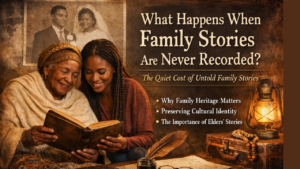
Why are African women expected to care for everyone? Explore African women as caregivers, emotional labor, and cultural expectations at home, at work, and across generations—and why documenting these stories matters.
The Work That Never Ends, Even After the Lights Go Out
When Sophia finally turns off her laptop at 9:47 p.m., her workday is technically over.
But the real work is just beginning.

Table of Contents
Her phone buzzes. Not with emails this time, but with messages from family WhatsApp groups. An aunt asking about funeral contributions. A sister checking on school fees back home. A reminder about a traditional gathering she must attend—and help organize—over the weekend.
Sophia exhales.
None of this appears on her CV. None of it earns her a promotion. Yet without her, much of it would fall apart.
This is the life of an African women caregiver in its quietest form. The invisible emotional labor that sustains families, preserves traditions, and keeps generations connected across continents and generations.
What Is Emotional Labor in African Women Caregiving?
Emotional labor is the mental and emotional effort required to care for others, anticipate needs, and hold families together.
For many African women, this includes:
- Remembering birthdays, rituals, and obligations
- Coordinating caregiving for children, the elderly, and extended family
- Managing family conflicts gently and discreetly
- Carrying cultural knowledge without formal recognition
In African households—whether in Nairobi, Toronto, London, or rural villages—this labor is often inherited, not chosen.
It is passed down as duty, not discussed as work.
Why Are African Women Expected to Be the Primary Caregivers?
Historically, African women have been positioned as:
- Life-givers (through childbirth)
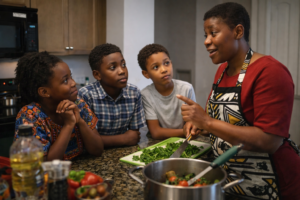
- Nurturers (through caregiving and food preparation)
- Cultural custodians (through rituals, language, and customs)
From an early age, girls are taught, —not through lectures, but through observation—that:
- They must notice what others overlook
- They must remember what others forget
- They must soften what others harden
Sophia remembers watching her mother juggle it all—teaching, farming, cooking, caregiving—without complaint. Only now does she realize how much went unspoken.
Caregiving Across Borders: African Women in the Diaspora
For African women in the diaspora, caregiving does not end with migration.
It simply becomes more complex.
Sophia sends money home. She coordinates medical appointments remotely. She checks in across time zones. She carries guilt for being “away” and the pressure to remain “present.”
Many women ask quietly:
- How do I care from afar without burning out?
- How do I honor tradition while building a modern life?
- Who takes care of the caregiver?
These questions rarely make it into family conversations, but they shape daily decisions.
When Women’s Caregiving Stories Go Undocumented, Heritage Disappears
Much of what African women do lives only in memory:
- Who nursed whom through illness
- Who mediated family conflicts
- Who kept traditions alive during hard seasons
When these stories aren’t written down, they fade.
Not because they were insignificant, but because women were too busy holding everything together to record them.
This is how family heritage becomes fragmented: not through neglect, but through exhaustion.
Why Documenting Stories of African Women as Caregivers Matters
Documenting caregiving stories:
- Honors invisible labor
- Validates lived experience
- Teaches future generations empathy and cultural context
- Preserves heritage beyond recipes and rituals
For daughters watching their mothers, and sons learning what care truly looks like, these stories offer something priceless: understanding.
A Reflection Exercise: Naming the Care Work You Carry
Take a moment and reflect:
- Who depends on you emotionally?
- What responsibilities do you carry that no one else sees?
- Who taught you how to care, and at what cost to themselves?
Write it down.
Not to complain.
Not to justify.
But to witness.
Because what is named can be shared.
What is shared can be reimagined.
Where This Story Is Headed
In upcoming posts, we will explore and review literature for:
- Caregiving burnout among African women
- Redefining cultural expectations without abandoning heritage
- How storytelling creates room for rest, balance, and change
- Why African women’s stories belong in literature, not just kitchens
These themes also live inside my trilogy, The Girl Who Left the Village, and in the novel, The Housegirl Becoming Angela, where educated African women confront the tension between ambition and tradition.

A Captivating Call to Action
If you are a woman balancing career, caregiving, and cultural expectations, your story matters.
Your labor matters.
Your exhaustion matters.
Your voice matters.
Start documenting, just one truth at a time.
Explore the Leave a Legacy, Not Regrets journaling series, created to help women preserve family stories, caregiving memories, and cultural heritage before they are lost to silence.
Because the work you carry deserves to be remembered.